
Tallinn Digital Summit 2026
How to Thrive in the Agentic Era? Competitiveness. Security. Efficiency
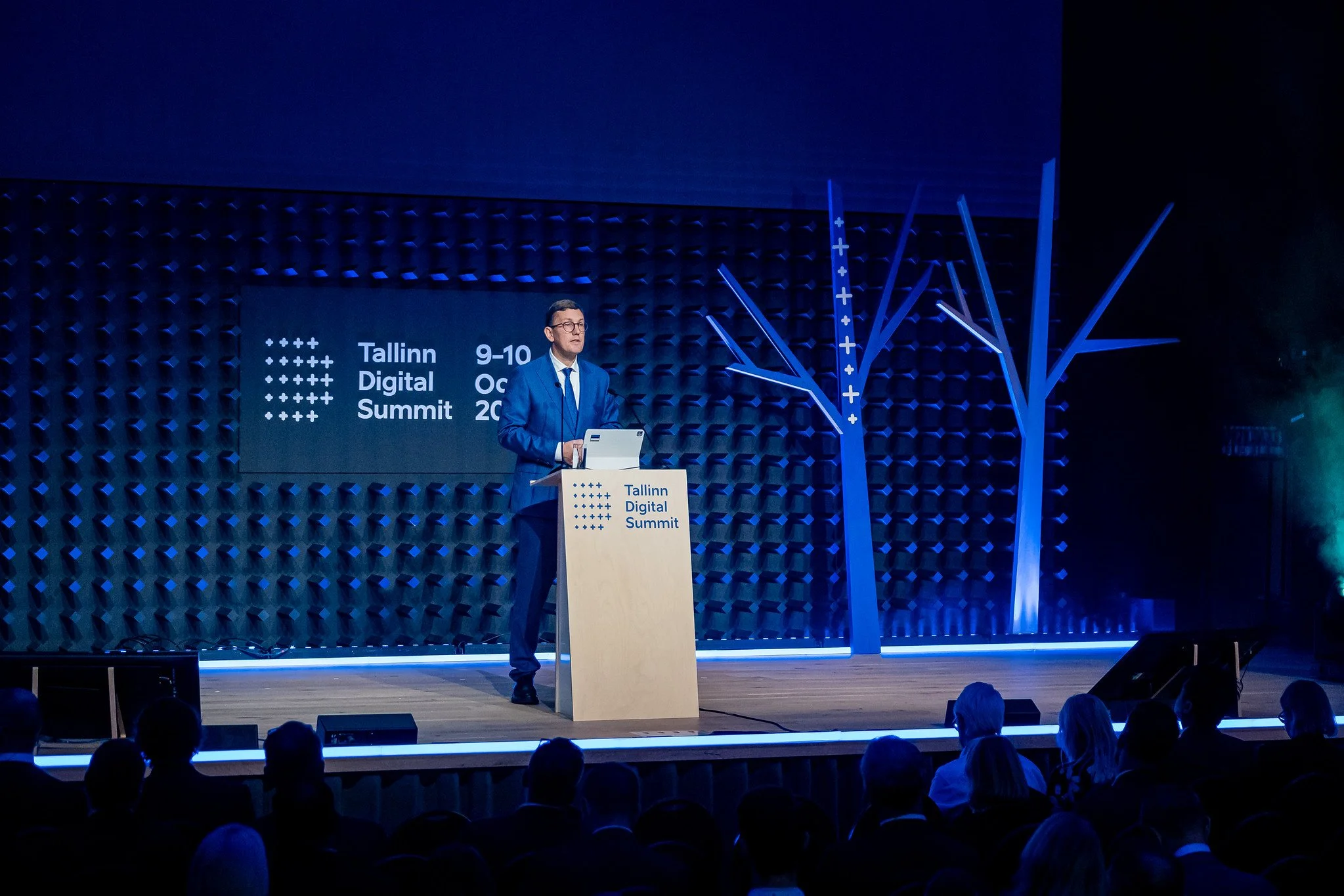
The Tallinn Digital Summit 2026 convenes at a moment of rupture, not transition. Deepening geopolitical uncertainty, with war in Ukraine showing no sign of resolve, has collided with technological change at a pace that outruns the capacity of governments, institutions, and societies to respond. Artificial intelligence and agentic systems, the most consequential technologies of our era, are being developed, deployed, and weaponised simultaneously. All this might be formulated as a challenge, but it should be seen as immense potential.
Democratic governments today have a powerful opportunity to build successful partnerships for the agentic era. As AI capabilities rapidly advance, closing the gap between what AI is expected to achieve and what it delivers is a priority—politically, economically, and strategically. This moment invites leaders to develop new partnerships and democratic models that are mutually empowering and enable the creation of agentic states: systems that are citizen-centric, democratically accountable, competitive, secure, and firmly grounded in the rule of law. The middle-powers need to find new ways of cooperation for resilience and faster collective action.
Resilience has become a key question in a complex and unpredictable geopolitical landscape. Efforts around digital sovereignty, countering hybrid and cyber threats, protecting critical infrastructure, and advancing the AI and other new technologies for defence purposes have become integral to everyday governance. The Summit also draws on the lessons of Ukraine’s wartime digital transformation – how digital governance, cyber resilience, and rapid innovation can reinforce state capacity under extreme pressure. With dual-use technologies now widespread, AI stands out as a key enabler. To maximise this potential, governments need to accelerate innovation by providing access to operational testing environments, simplifying procurement processes, and increasing funding opportunities. Together, these steps can foster a dynamic ecosystem where innovation and public value reinforce each other.
AI gives democracies the possibility to deliver through an agentic state and reduce costs for the taxpayers. A state that is proactive and does not require unnecessary interaction, while transparency is ensured, and citizens have control over their data. In this setting, the businesses and individuals can direct their most precious resource - time - towards creating value rather than navigating bureaucracy. But while AI's economic potential is estimated in trillions, fewer than 5% of organisations and even fewer governments globally have realised substantial financial gains from this technology. This forces governments and leaders to rethink how agentic states are envisioned, deployed, and governed, how to transform the workforce, and how to drive change together with trusted technology providers.
In this context, TDS 2026 structures its conversations across three strategic pillars — new democratic formats and partnerships for the agentic era; defence and digital resilience amid geopolitical tensions; and AI and emerging technologies applied for trusted governance and enhanced competitiveness. The question we ask is: how to thrive in the agentic era and transform AI expectations into pragmatic, trusted, and reliable solutions that help democracies endure, and economies grow.
Estonia is a small, fully digital nation that has recently launched several important initiatives like Eesti.ai, which is a nation-wide programme in collaboration with international experts and startup unicorn founders with concrete targets: to double the value of Estonian labour by 2035 through AI, and to grow the economy by 25% within five years and 50% within a decade. Simultaneously, Estonia is investing in the next generation through the AI Leap initiative — a landmark public-private partnership with leading global AI companies that brings advanced tools directly into classrooms, ensuring that critical thinking, cyber resilience, and AI & tech literacy become the foundation of our workforce. This is our second-generation Tiger Leap — and it is already underway.
The 2026 edition of the Tallinn Digital Summit offers a unique, invitation-only forum for constructive and pragmatic dialogue among leaders from the political, business, innovation, financial, digital, and defence domains. As Estonia chairs both the Nordic-Baltic 8 and Digital Nations in 2026, the Summit advances the shared ambition to build the world's most digitally integrated region. We are inviting like-minded nations, technology leaders, and business pioneers to shape the answer together. The Tallinn Digital Summit 2026 is where that work begins.
The Summit takes place on 5–6 November 2026 at the National Library of Estonia.
For further information, please contact:
Kata Varblane
Director
Tallinn Digital Summit
tds@icds.ee